
Sony’s latest patent suggests that the PlayStation 6 could use AI-powered frame generation to predict upcoming gameplay images, potentially improving visual smoothness while addressing the input latency associated with existing frame-generation technologies.
Sony Patent Points to Possible AI Frame Generation on PS6
Sony could be exploring a new way to make future PlayStation games look smoother without relying entirely on conventional GPU rendering. A newly published patent titled Generation Super Sampling describes a system that uses artificial intelligence to predict upcoming gameplay images, raising the possibility that similar technology could eventually feature in the PlayStation 6 (PS6).
The patent, published on October 15 and highlighted by Patentlyze, outlines a technique that generates predicted images from previously rendered gameplay frames. The system can also consider motion information and optional player inputs to estimate what should appear next.
However, a patent does not confirm that a technology will reach a commercial product. Sony has yet to officially reveal the PS6’s hardware specifications or confirm whether this particular frame-generation technique will be used in its next-generation console.
If implemented successfully, the approach could help Sony improve gaming performance and visual fluidity while exploring ways to limit the additional latency that can accompany AI-generated frames.
How Sony’s Proposed Frame Generation Technology Could Work
Conventional graphics rendering involves a GPU calculating the images displayed during gameplay. Frame-generation technologies take a different approach by creating additional frames between traditionally rendered images, making movement appear smoother without requiring every displayed frame to be rendered from scratch.
Sony’s patent describes a system built around an encoder and a decoder. The encoder analyzes previously rendered gameplay images and converts relevant visual information into embeddings, which are then used by the decoder to predict a future image.
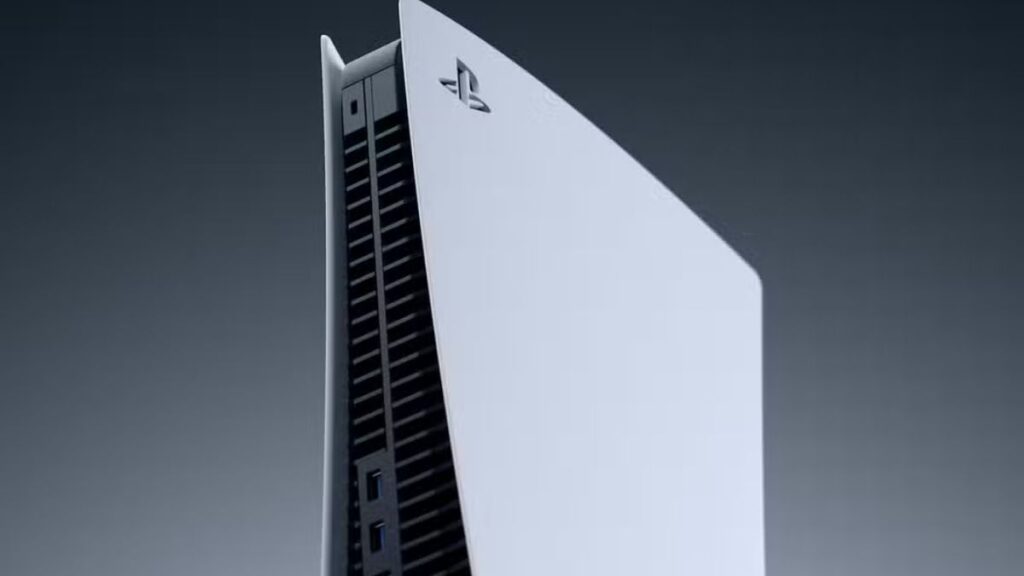
The proposed process can also incorporate motion vectors and, optionally, information about the player’s recent actions. Inputs such as joystick movements, button presses, and mouse movements could provide additional context about how the game is likely to change.
For example, if a player moves the camera to the right, the system could use that input alongside visual and motion data to estimate how the next image should look. Meanwhile, the conventional graphics pipeline could continue rendering the next actual frame.
By predicting what may happen next rather than relying exclusively on completed frames, the technique could offer an alternative approach to generating additional images during gameplay. The patent also discusses predicting multiple future frames, although the practical performance and accuracy of such a system remain unknown.
Could PS6 AI Frame Generation Reduce Input Lag?
One of the biggest challenges associated with frame generation is balancing smoother visuals with responsive controls.
Technologies such as NVIDIA DLSS Frame Generation and AMD FSR Frame Generation can increase the number of displayed frames by inserting AI-generated or algorithmically generated images between conventionally rendered frames. This can make fast-moving scenes appear smoother, particularly when the underlying game already runs at a reasonable frame rate.
However, generated frames do not automatically make a game respond faster to player inputs. Depending on the implementation, frame generation can introduce additional latency, and the actual experience depends on factors such as rendering performance, synchronization, and latency-reduction techniques.
Sony’s proposed method could approach this challenge differently by using player inputs and motion information to help predict upcoming images. Knowing that a player has moved a joystick or pressed a button may give the model additional information about the likely direction of movement or camera changes.
That information could help the system generate frames that better reflect the player’s actions. Nevertheless, the patent does not establish that the technology will eliminate input lag or outperform existing solutions in real-world gaming. Its effectiveness would depend on implementation details, prediction accuracy, hardware performance, and how the generated images are integrated into the rendering pipeline.
Sony’s Project Amethyst Could Help Shape PS6 Graphics
The patent also fits into Sony’s broader work on machine-learning graphics and rendering technologies. Through Project Amethyst, its collaboration with AMD, Sony has been exploring approaches intended to improve graphics processing and make more efficient use of GPU resources.
The collaboration has discussed several technologies, including Neural Arrays for coordinating machine-learning workloads, Radiance Cores for accelerating ray tracing and path tracing, and Universal Compression for reducing memory-bandwidth requirements.
These developments address different parts of the graphics pipeline, but they share a broader objective: improving visual quality and rendering efficiency through specialized hardware and software techniques.
Sony’s PlayStation 5 Pro already uses PlayStation Spectral Super Resolution (PSSR), an AI-assisted upscaling technology designed to improve image quality while reducing the rendering workload required to produce a higher-resolution output.
A future frame-generation solution could complement technologies such as PSSR by addressing a different aspect of graphics performance. Upscaling reconstructs a higher-resolution image from a lower-resolution rendering, whereas frame generation creates additional images to increase the apparent smoothness of motion.
If Sony combines these approaches in a future console, it could potentially deliver improvements in resolution, frame rates, and visual effects without relying solely on increases in raw GPU performance. However, the patent does not confirm that the proposed system is directly connected to PSSR or that all these technologies will appear together in the PS6.
PS6 vs. Next-Generation Xbox: AI Graphics Could Become a Key Battleground
Sony is not the only console manufacturer preparing for the next generation of gaming hardware. Microsoft has announced Project Helix, its next-generation Xbox initiative, which is being developed around a custom AMD system-on-chip and future graphics technologies.
Microsoft has highlighted improvements in areas such as ray tracing and graphics processing as part of its next-generation ambitions. The company has also indicated that Project Helix will support both console and PC gaming experiences, although its final specifications and retail release details remain subject to official announcements.
The two companies could therefore approach next-generation performance through a combination of faster hardware, more advanced rendering techniques, and machine-learning capabilities.
For Sony, AI-powered frame generation could offer another way to improve the perceived performance of demanding games. Instead of depending entirely on a more powerful GPU to render every displayed frame, a future PlayStation could use predictive rendering to supplement conventional graphics processing.
For developers, the challenge will be ensuring that these techniques improve visual fluidity without introducing distracting image artifacts, inconsistent motion, or noticeable control delays. The quality of the underlying game engine and the integration of the technology will remain important.
When Will Sony PS6 Launch?
Sony has not officially announced the PS6’s launch date, price, or final hardware specifications. Consequently, the company’s recently published patent should not be treated as confirmation of a particular feature or release schedule.

Patent filings document ideas and potential technical approaches, but companies frequently investigate technologies that never make it into consumer products. Even if Sony continues developing this frame-generation method, it could be revised, combined with other approaches, or reserved for future hardware.
The same caution applies to predictions about the PS6’s performance. The patent alone does not reveal how much frame-rate improvement the technology could deliver, which resolutions it might support, or whether it would operate across all games.
For now, Sony’s research offers a useful indication of the graphics technologies it may be exploring for the future of PlayStation. More concrete details will depend on official announcements and further technical disclosures.
Final Thoughts
Sony’s Generation Super Sampling patent points to a potentially interesting direction for next-generation console graphics: using AI to predict future gameplay images while incorporating motion data and player inputs.
If the approach proves practical, it could help make PS6 games appear smoother while giving Sony another tool to balance image quality, performance, and responsiveness. Its potential significance lies in how predictive rendering might complement existing technologies such as PSSR and the graphics innovations being explored through Project Amethyst.
For now, however, AI frame generation remains a potential PS6 development rather than a confirmed console feature. Sony’s next-generation plans will become clearer only when the company officially reveals more about its hardware and software strategy.
