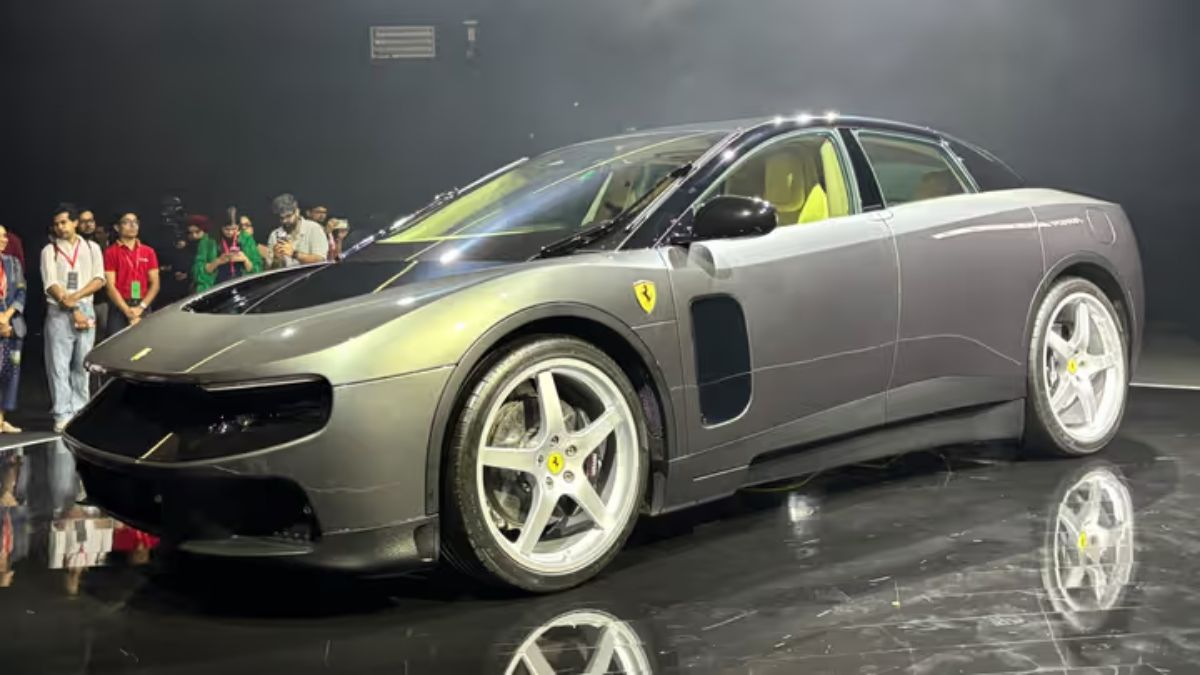
Ferrari Luce EV: Ferrari has confirmed that it developed a patent for a compressed-air jet system in 2019, years before Tesla showcased similar technology for its next-generation Roadster. However, the Italian supercar manufacturer had a different objective in mind: improving a car’s grip, braking, acceleration, and cornering performance rather than lifting it off the ground.
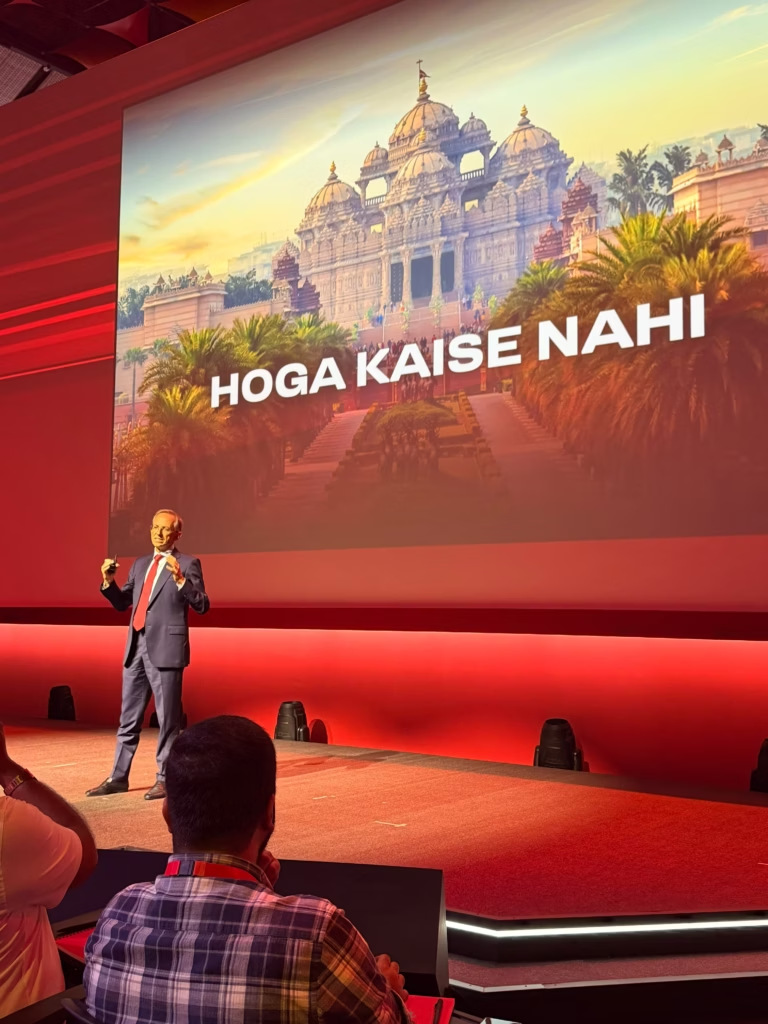
Ferrari CEO Benedetto Vigna discussed the technology in an exclusive interview with Hindustan Times in New Delhi, where the company introduced its first all-electric car, the Ferrari Luce, to Indian audiences. The event also marked the first Indian edition of the Universo Ferrari exhibition, giving visitors an opportunity to explore the brand’s latest performance-focused innovations.
Vigna also addressed the future of electric supercars, the response to the Luce’s design, Ferrari’s ambitions in India, and why the company believes driving excitement must remain at the centre of its engineering decisions.
Ferrari Developed an Air-Jet Patent Before Tesla’s Latest Roadster Demonstration
Ferrari’s interest in compressed-air propulsion technology dates back several years. According to Vigna, the company filed a patent in 2019 for a system that could use directed air jets to improve the performance of a car travelling on conventional wheels.
The design is associated with Ferrari engineer Fabrizio Favaretto, who was named as its inventor. Vigna confirmed that he was familiar with the proposal and acknowledged its similarities to the technology demonstrated by Tesla.
“Yes, there is a patent from Ferrari in 2019 from our colleague. I know it very well,” Vigna said, referring to Favaretto’s work.
The key distinction is how the technology would be used. Ferrari’s concept was designed to help a vehicle maintain better contact with the road during demanding driving situations. Tesla, meanwhile, has presented compressed-air thrusters as a way to enable dramatic aerial movements in its next-generation Roadster.
Although the underlying engineering principle is similar, the intended driving experiences are substantially different.
How Ferrari’s Compressed-Air Jet System Would Work
Ferrari’s patent, titled High-Performance Car with Gas Pushers, describes a system intended to supplement the forces generated by a car’s tyres.
During aggressive driving, a vehicle eventually reaches the limits of its available tyre grip. At that point, additional acceleration, braking or cornering becomes increasingly difficult without compromising stability.
Ferrari’s proposed solution uses a high-pressure air reservoir connected to strategically positioned nozzles. The patent describes storing air at pressures of approximately 700 to 900 bar, allowing the system to release directed jets when additional forces are needed.
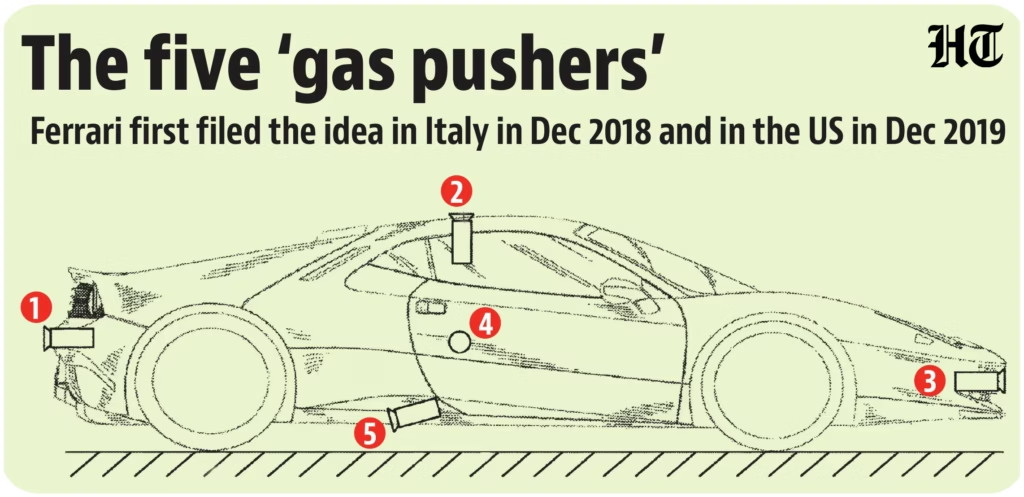
The proposed arrangement includes several components with different functions:
- Downforce generation: An upward-directed jet near the vehicle’s centre of gravity produces a reaction force that pushes the car towards the road.
- Cornering assistance: Side-mounted jets are intended to counter forces that push the vehicle outward during a turn.
- Braking support: A forward-directed jet could generate a force that helps slow the vehicle.
- Acceleration assistance: A rear-facing jet could provide additional forward thrust.
- Underbody airflow management: A jet beneath the vehicle could influence airflow under the floor, potentially helping reduce pressure beneath the car.
Together, these features aim to improve vehicle control in situations where conventional tyre grip approaches its limits.
The patent also proposes using a wheel-driven compressor to replenish the air reservoir during braking. This arrangement could recover some energy that would otherwise be dissipated as heat.
According to the patent’s estimates, the complete system would add approximately 40–45 kilograms to the vehicle. Its practical effectiveness, efficiency, safety and production feasibility would still need to be assessed in the context of an actual vehicle.
Importantly, the design is intended to keep the car on the road. It does not describe a flying Ferrari.
Ferrari Filed the Patent in 2018 and 2019
The timeline of Ferrari’s compressed-air technology provides an interesting comparison with Tesla’s more recent demonstration.
Ferrari initially filed the patent in Italy on December 27, 2018, before submitting a US application on December 23, 2019. The American application was published in July 2020 and subsequently granted as US patent 11,072,381.
Around the same period, Tesla CEO Elon Musk discussed plans to equip the next-generation Roadster with SpaceX-inspired thrusters.
Ferrari’s patent attracted attention from automotive publications in 2023, but Vigna’s comments provide an on-record confirmation from the company about the engineering concept and its intended purpose.
A patent, however, does not automatically mean that a technology will enter mass production. Automakers regularly investigate and protect engineering ideas that may be modified, developed further or never introduced in a production vehicle.
For Ferrari, the proposal illustrates how the company explores unconventional technologies to improve the connection between the driver, the car and the road.
Tesla Roadster Uses a Different Approach to Compressed-Air Thrusters
Tesla has approached the same broad engineering principle from a different direction.
During its latest Roadster demonstration, the company showcased compressed-air thrusters performing an airborne manoeuvre over a row of parked Tesla vehicles. The display was designed to demonstrate the capabilities of the forthcoming electric sports car and generate excitement around its performance ambitions.
The demonstration highlighted the potential for directed compressed air to generate substantial forces. However, Tesla’s intended application differs from Ferrari’s proposed system.
Ferrari’s concept focuses on maintaining traction and improving control during demanding driving conditions. Tesla’s presentation emphasises dramatic movements that take the vehicle away from the road.
Speaking about the difference between technological spectacle and practical driving benefits, Vigna explained that Ferrari evaluates new developments according to the experience they deliver to the person behind the wheel.
“What is important is that we understand if the technology we bring forward is a technology that delivers unique emotion, driving thrill, or something that is more on the sensational side,” he said.
He added that engineering should begin with human needs rather than the technology itself.
For Ferrari, that philosophy means a new feature must justify its place by making the driving experience more engaging, rather than simply attracting attention.
Ferrari Luce EV Makes Its India Debut
Alongside the discussion about future automotive technology, Ferrari introduced the Luce, its first all-electric car, to Indian audiences.
The model was showcased at Universo Ferrari at Yashobhoomi, the India International Convention and Expo Centre in New Delhi. The exhibition ran from October 17 to November 1 and also featured the F80 hypercar, which made its Indian debut at the event.
The Luce represents an important development for a manufacturer whose identity has traditionally been closely associated with high-performance combustion-engine sports cars.
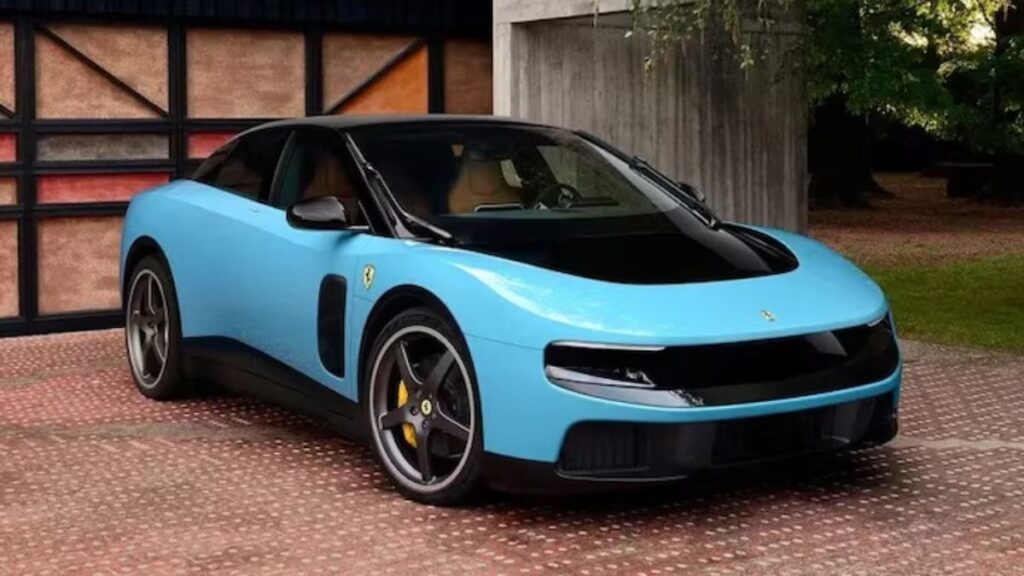
Its design was developed in collaboration with LoveFrom, the creative studio founded by former Apple design chief Jony Ive and designer Marc Newson.
The vehicle’s headline specifications include:
- Power output: 1,035 horsepower from four electric motors.
- Battery capacity: 122kWh.
- Claimed range: Approximately 529 kilometres.
- Vehicle type: An all-electric sports car developed for Ferrari’s expanding performance portfolio.
These figures position the Luce as a high-performance electric vehicle, although real-world range and energy consumption will depend on driving conditions, temperature, speed and other factors.
Ferrari has not announced Indian pricing or a confirmed sales date for the Luce.
Why Ferrari CEO Benedetto Vigna Is Defending the Luce’s Design
The Luce has not received universal approval since its unveiling.
Its reveal near Rome on May 25 prompted criticism of its design, and Ferrari shares fell 8.4% in Milan the following day amid the negative reaction. Former Ferrari chairman Luca di Montezemolo also warned that the company risked damaging the legacy associated with its name.
Vigna, however, remains confident in the direction Ferrari has taken.
“True innovation is never democratic,” the CEO said, reiterating a line from an article he had written shortly before the car’s launch.
He explained that innovations can attract resistance when they challenge familiar expectations. In his view, widespread acceptance is not necessarily an immediate requirement for a genuinely new idea.
Vigna said he would not change the decisions made during the Luce’s development and was not surprised by the reaction to its unveiling.
He acknowledged that the number of social-media impressions was the one aspect he might have misjudged. Nevertheless, he argued that companies seeking to maintain a leadership position must continue to push boundaries instead of simply following established trends.
The Ferrari CEO also believes photographs and videos do not fully communicate the car’s design.
According to Vigna, people who encounter the Luce in person can form a different impression from those who have seen it only on a screen. He believes the physical experience is essential to understanding the vehicle.
Strong Interest in China as Ferrari Expands Its Electric Strategy
Despite the debate surrounding the Luce, Vigna said interest in the vehicle was coming from several markets.
He described demand in China as particularly strong, noting that customers there are generally more accustomed to electric vehicles. According to his comments, all 88 cars in the first Chinese allocation sold out on launch day in June.
The response could provide Ferrari with useful insight into how its customers view an electric sports car bearing the Prancing Horse badge.
However, Ferrari is not presenting the Luce as the beginning of an immediate, complete transition away from combustion engines.
Vigna made the company’s position clear: “We are adding an electric car to our sports car portfolio. We are not switching to electric.”
He also declined to criticise rival supercar manufacturers that have adjusted or slowed their electric-vehicle plans.
“Technology can move fast. Human beings move slower,” he said, suggesting that customer preferences will ultimately influence how different manufacturers develop their future line-ups.
For Ferrari, the strategy is to give customers more choices while preserving the emotional qualities that have helped define the brand.
Ferrari Sees Opportunities in India and the European Union Trade Agreement
India is becoming an increasingly important market for global automotive brands, and Ferrari is paying attention to the opportunities it presents.
During his visit, Vigna said customers he had met in India were pleased about the free trade agreement between India and the European Union.
“This FTA is something that I see as very good news for us,” he said.
The agreement could have implications for trade between the two markets, although its eventual impact on imported vehicle prices will depend on the final terms, implementation and applicable regulations.
Vigna also highlighted the contribution of Indian professionals working with Ferrari.
“We already have many Indian colleagues that are giving a strong contribution to what we do,” he said.
The CEO planned to meet students from the Indian Institutes of Technology and other universities during his visit. He praised the energy and optimism he encountered among young people in the country.
When discussing Ferrari’s outlook in India and Asia, Vigna also used the Hindi expression “Hoga Kaise Nahin?”, meaning “Why won’t it happen?”
The phrase reflected his emphasis on determination, confidence and the willingness to pursue ambitious goals.
Ferrari Believes Autonomous Driving Will Not End the Joy of Driving
Beyond electrification, Ferrari is also considering how autonomous technology could influence the future of personal mobility.
Vigna does not believe self-driving vehicles will eliminate the desire to drive manually, particularly among enthusiasts who value control and involvement.
Ferrari produces approximately 14,000 cars annually, according to the CEO, serving a relatively small segment of the global population.
He believes that customers who seek an emotional connection with a sports car will continue to want the experience of driving themselves.
“If you want to have fun, if you want to live emotion, you have to drive by yourself,” Vigna said.
For Ferrari, the challenge is not necessarily to reject emerging technologies but to ensure the company remains relevant to people who value the traditional driving experience.
This philosophy also helps explain the company’s interest in performance-enhancing engineering. Whether a feature involves electric motors, advanced aerodynamics or compressed-air systems, its value ultimately depends on what it contributes to the driver.
Ferrari’s Manufacturing Philosophy Still Depends on Human Skill
Vigna also discussed the role of people in Ferrari’s manufacturing operations at Maranello, Italy.
Despite advances in industrial automation, he described a production process that relies heavily on skilled workers and their craftsmanship.
“You don’t see robots. There’s only one robot,” he said, explaining that the robot places the windscreen onto the vehicle frame.
He added that the rest of the work is carried out by people using their individual skills.
The explanation reflects Ferrari’s emphasis on craftsmanship and the distinct character of its vehicles. Rather than treating every car as an identical mass-produced product, the company places importance on the human contribution to manufacturing.
Vigna compared a business to a nut: the outer shell represents the strength of the brand, the kernel represents its core values, and employees form the connection between the two.
He described everyone working at Ferrari as a guardian of the brand, emphasising the responsibility that comes with preserving its reputation.
Benedetto Vigna’s Advice for Young Engineers
Vigna’s own career offers a perspective on the value of continuous learning.
Before becoming Ferrari CEO, he worked in the semiconductor industry. Having grown up in a small Italian town, he also understands the importance of curiosity and determination when pursuing ambitious professional goals.
When asked what advice he would offer an engineer from a small town in India, Vigna emphasised the importance of remaining open to new ideas and learning from other people.
His message was straightforward: “Keep learning everywhere, from everyone, always.”
The advice aligns with Ferrari’s broader approach to innovation. The company continues to explore new engineering solutions while attempting to preserve the driving character, craftsmanship and emotional appeal associated with its cars.
What Ferrari’s Luce EV and Air-Jet Patent Mean for the Future
Ferrari’s compressed-air patent and the Luce electric sports car illustrate two different aspects of the company’s technology strategy.
The patent demonstrates how Ferrari has explored unconventional methods of improving traction and vehicle control. The Luce, meanwhile, represents a more visible step into electric performance, bringing four electric motors and a large battery into the company’s sports car portfolio.
Neither development changes Ferrari’s stated commitment to offering multiple approaches to performance rather than abandoning its existing identity.
The company’s challenge will be to turn technological ambition into products that customers want to own and drive. For the Luce, that means convincing enthusiasts that electrification can deliver the emotional qualities they expect from a Ferrari. For experimental technologies such as compressed-air jets, it means demonstrating tangible benefits that justify their complexity and cost.
Vigna’s position is that innovation should be judged by what it achieves, not simply by how quickly it wins public approval.
As Ferrari expands into electric mobility, its success will depend on whether it can combine new technology with the performance, craftsmanship and driver involvement that have defined the brand for generations.
(Source)
